The $0.14 Question: How DeepSeek Is Disrupting Anthropic's Pricing Empire
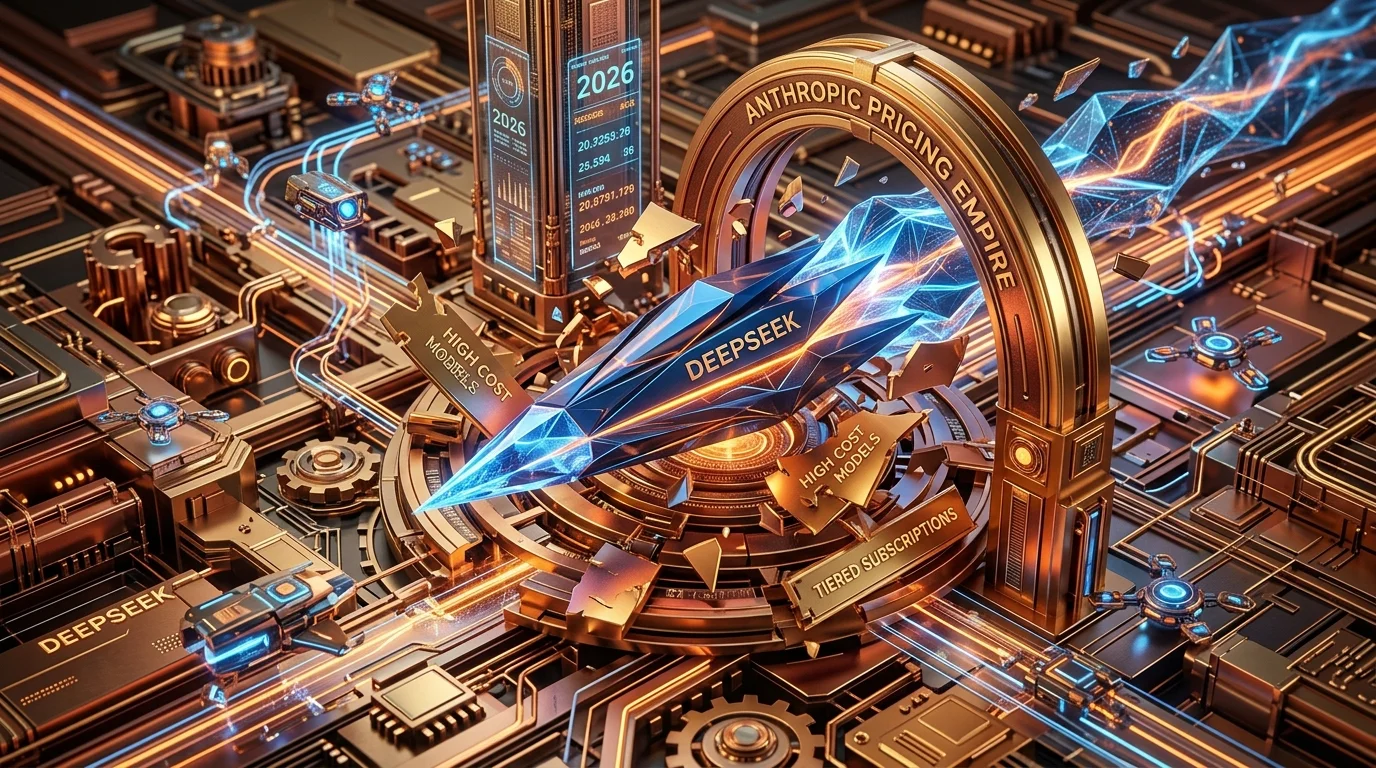
Quick Take
- DeepSeek V4 Flash: $0.14 per million input tokens
- Core pressure point: similar capability at radically lower cost
- What changes: AI pricing is becoming a platform selection issue, not a procurement footnote
- Main loser if this trend holds: premium model vendors relying on large pricing spreads
The AI battlefield has shifted. While Anthropic confidently raised valuations to $380 billion and announced plans to go public in Q4 2026, a Chinese startup quietly launched a model that performs similarly at 1/100th the cost.
The Shock Heard 'Round Silicon Valley
DeepSeek V4 Flash runs at $0.14 per million input tokens, making it up to 100 times cheaper than Anthropic's flagship model. For context: Anthropic's Claude Opus 4.6 starts at $0.25/M input tokens, and the cost disparity only widens for output tokens.
This isn't a marginal improvement. This is structural disruption.
In March 2026, the numbers tell a brutal story. When Kilo Code compared the cost of Claude 4.6 Opus to MiniMax M2.7, it found that MiniMax M2.7 delivered 90 percent of the quality for 7 percent of the cost ($0.27 total vs $3.67). That's not a 20% savings. That's not a volume discount game. That's an order-of-magnitude economic reset.
Performance Parity Is Here
Here's the part that keeps Anthropic's leadership awake at night: the models are competitive on benchmarks.
DeepSeek's V4 model, released in April 2026, is posting benchmark scores that sit alongside GPT-5.5 and Claude Opus 4.7 on agentic tasks. This is not a case of "you get what you pay for." This is a case of "you pay 100x more for the same thing."
Qwen3-Max scores 90.5 on Arena-Hard (User Preference Alignment), ahead of DeepSeek V3.2 (87.1) and Claude Sonnet 4.6 (86.4). The performance ranking is already shifting toward Chinese models.
How Did DeepSeek Do This?
The answer is both simple and unsettling for Western AI labs: efficiency and ruthless engineering.
DeepSeek proved with its R1 model in January 2025 that frontier AI does not require frontier budgets. R1 matched OpenAI's top reasoning model while reportedly costing less than $6 million to train.
Compare this to Anthropic's reported training costs, roughly a quarter of OpenAI's, but still orders of magnitude higher than DeepSeek's approach. The Chinese lab cracked something fundamental: how to build capable models with surgical efficiency instead of brute-force compute.
The Ripple Effect: What This Means for Developers
If you're building at scale, the math is inescapable.
For a mid-size SaaS company processing 10 billion tokens per month:
- Anthropic Claude: ~$2.5M annually
- DeepSeek V3.2: ~$27K annually
That's not a procurement negotiation. That's a platform decision that changes your entire business model.
In 2026, single-provider strategies are increasingly rare among smart operators. A typical hybrid approach looks like:
- Default tier: DeepSeek V3.2 for 70-80% of volume, especially structured extraction, summarisation, and drafting
- Mid tier: GPT-5 Mini for assistant-style interfaces and chat where OpenAI's ecosystem adds value
- Premium tier: GPT-5 or Claude Opus only for the highest-value, highest-risk tasks
The Uncomfortable Truth for Anthropic
Anthropic has seen its market share slip from 29.1 percent on March 22, 2025 to 13.3 percent on March 21, 2026. That's a 55% collapse in market dominance in just one year.
The company raised $30 billion and has only managed to turn $5 billion in revenue while spending $10 billion on inference and training costs. The IPO is coming, but the financial picture is sobering.
Anthropic positioned itself as the safety-first alternative to OpenAI. That earned goodwill. But in 2026, safety features do not offset a 100x cost disadvantage when the performance is the same.
Where Does This End?
The Silicon Valley narrative was always: American labs innovate, Chinese labs copy. The 2026 reality is different. Chinese labs are innovating on cost, on efficiency, and increasingly on raw capability.
Presently, the top six models in that ranking come from Chinese AI companies. They include MiMo-V2-Pro (Xiaomi), Step 3.5 Flash (stepfun), DeepSeek V3.2 (DeepSeek), MiniMax M2.7 (MiniMax), MiniMax M2.5 (MiniMax), and GLM 5 Turbo (z.ai). Anthropic's Claude Opus 4.6 and Claude Sonnet 4.6 currently occupy slots seven and eight.
Anthropic won't disappear. Enterprise customers with regulatory requirements will continue paying the premium. But the era of Anthropic's cost-plus dominance is over. The question now is whether they can compete on something other than pricing: differentiation, vertical specialization, or the elusive safety dividend.
In May 2026, that question remains unanswered.
Explore Prompt Library
Browse prompt packs and copy-ready prompts for research, writing, coding, and client work.
Explore Prompt Library →