US AI vs Chinese AI: The Fierce Battle for Global Dominance
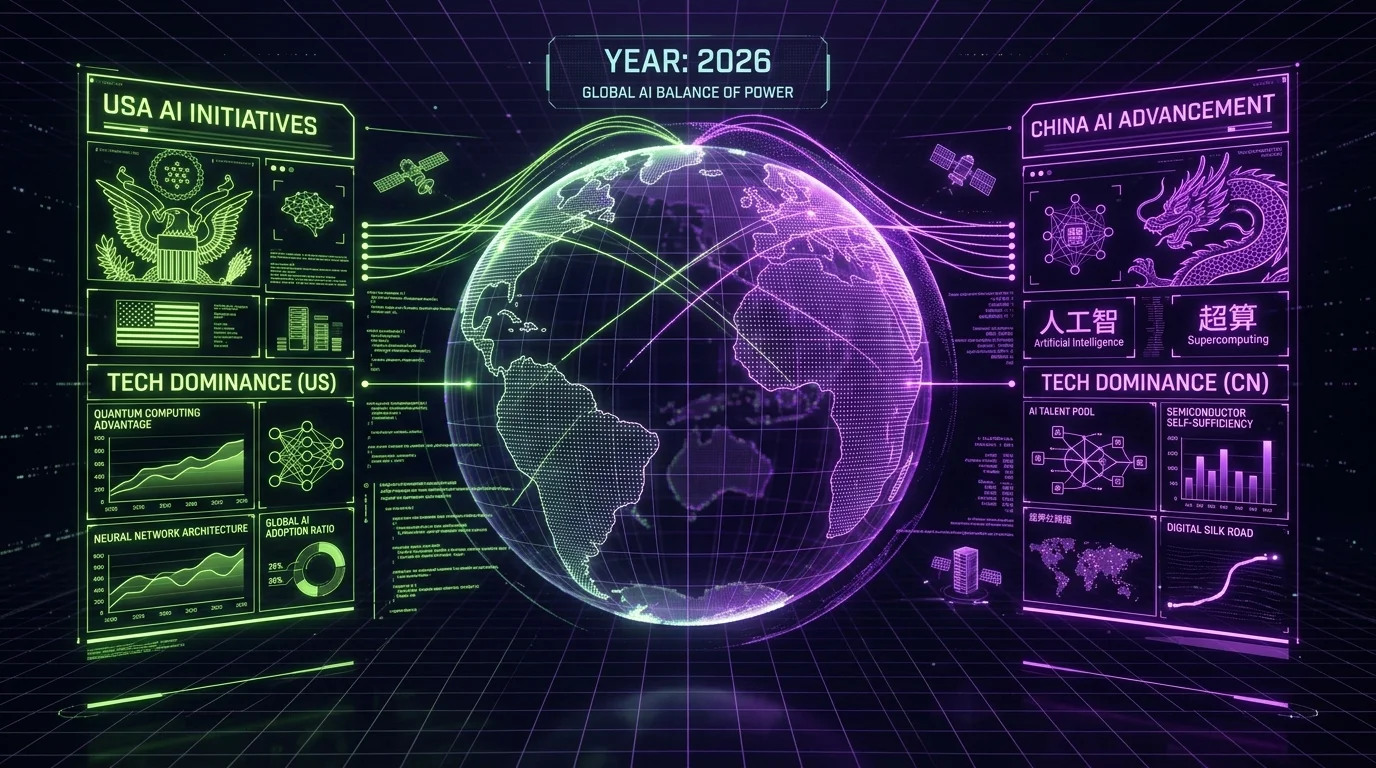
⚡ Quick Summary
- • Chinese open-weights models (DeepSeek-R1, Qwen 2.5) are matching or exceeding US closed models in coding and math.
- • A massive price war is driving API calling costs down, with Chinese providers charging 1/10th of their US counterparts.
- • Questions arise regarding whether Chinese open-weights AI will stop being free once they gain a dominant market share.
- • The US focuses on high-end closed models (like GPT-5 and Claude 4) while China dominates cost-efficient open-source distribution.
The geopolitical landscape of artificial intelligence is undergoing a dramatic shift. While American giants like OpenAI, Google, and Anthropic continue to push the absolute limits of closed-source reasoning models (such as GPT-5 and Claude 4), Chinese tech conglomerates and startups are executing a highly coordinated open-source counter-strategy. The gap in raw model capability has narrowed to almost zero, setting off a massive trade and technological battle.
The Open-Weights Surge: DeepSeek and Qwen
For years, Silicon Valley dismissed Chinese AI as copycat models lagging 12–18 months behind. That narrative shattered in early 2026. The release of DeepSeek-R1 and Alibaba's Qwen 2.5 family proved that Chinese developers could train state-of-the-art models on restricted GPU counts by optimizing algorithm efficiency. These models match or exceed US counterparts on critical benchmarks like MATH, code generation, and multilingual tasks.
More importantly, these models are distributed with open weights. Anyone can download them, host them locally, or run them in private enterprise networks. This has made them an instant favorite for developers globally who want to avoid the vendor lock-in of proprietary US APIs.
The Brutal API Price War
The emergence of highly capable open-source Chinese models has triggered a brutal price war. API developers can now access reasoning models for a fraction of a cent. For example, DeepSeek's API charges just $0.14 per million input tokens, compared to OpenAI's $15.00 for flagship closed-weights models. This represents an nearly **99% discount**, forcing US developers to drastically slash their own pricing to remain competitive in the business intelligence and developer markets.
The Multi-Million Dollar Question: Will Chinese AI Stop Being Free?
As Chinese open-weights models capture massive global market share, industry analysts are beginning to raise flags. Historically, tech platforms employ "loss leader" strategies—providing services for free to wipe out competition, only to introduce high licensing fees once the market is locked in.
Will Chinese AI firms follow this script? If startups like DeepSeek succeed in replacing proprietary US models inside global corporate stacks, they will hold massive leverage. While core weights are open-source and cannot be "recalled," future updates, safety patches, and highly specialized reasoning modules could easily be locked behind subscription models or state-approved enterprise licenses. Furthermore, compliance with strict domestic regulations might eventually force these developers to restrict access in Western markets.
Looking Ahead: Global Dominance
In the near term, this battle benefits end-users and developers by providing incredibly cheap, highly capable models. However, the division of the AI world into US-based proprietary giants and Chinese-dominated open-source weights has created a complex web of security, sovereignty, and business considerations. Whether American players can maintain their premium value proposition in a world saturated with free, state-of-the-art open weights remains the defining question of 2026.
Get Our Free AI Tools Guide
Join 50k+ freelancers getting weekly AI tips and tool reviews.
Explore Prompt Library →