When Will AGI Actually Arrive? Inside AI's Biggest Disagreement
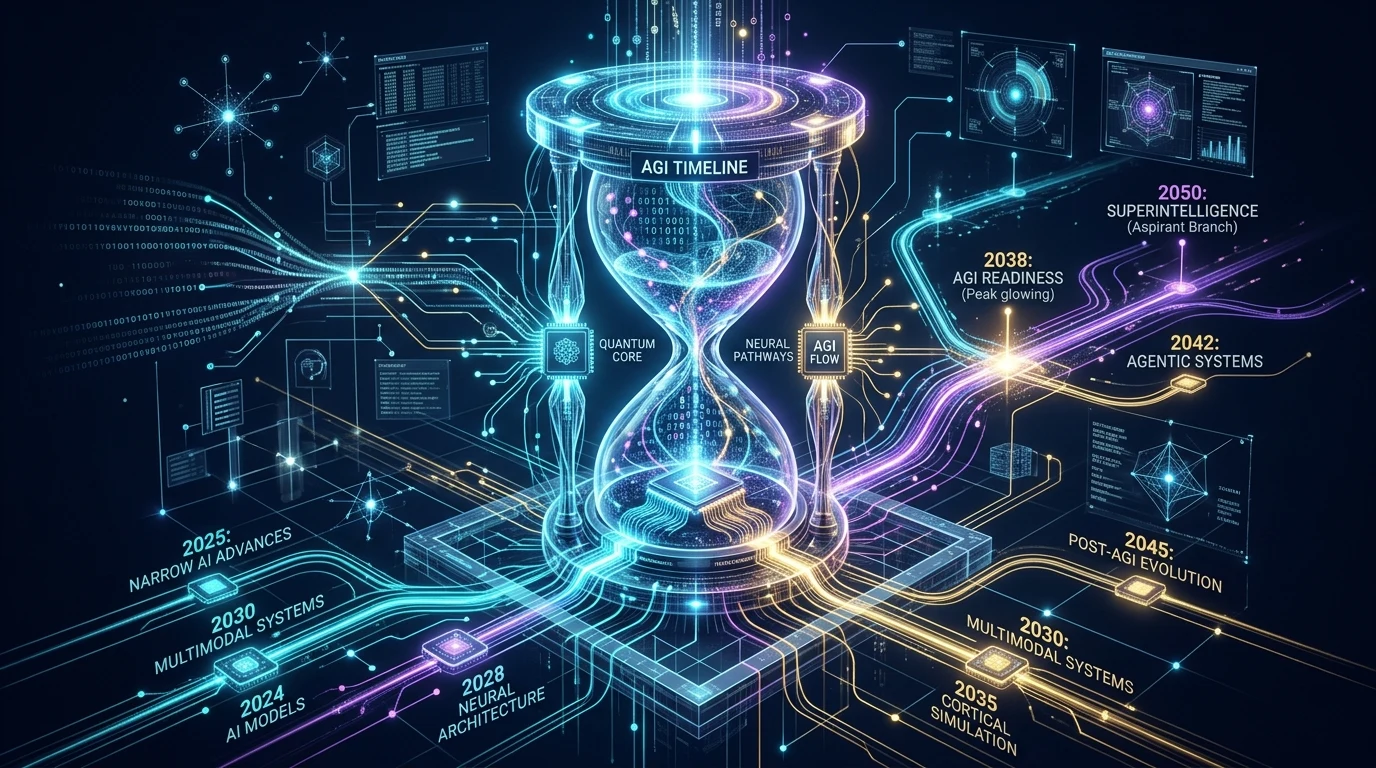
⚡ Expert Timeline Summary
- ✓ The Optimists (2026–2027): Altman, Amodei, and Musk see superintelligence / powerful AI arriving imminently.
- ✓ The Moderates (5–10 Years): Hassabis, Hinton, and Metaculus consensus put 50% probability by 2033.
- ✓ The Skeptics (Wrong Architecture): Yann LeCun argues LLMs cannot reach AGI without physical world JEPA models.
- ✓ Definitional Split: Economic task performance vs benchmark suites vs grounded physical intelligence.
- ✓ Compounding Progress: AI software task length reliability doubles every 4 months since 2024.
Ask the people building frontier AI when artificial general intelligence will arrive, and you'll get answers ranging from "essentially now" to "maybe never, with this approach." That's not a minor rounding error — it's one of the widest, most consequential disagreements among genuine experts in any active field of technology. Here's an honest look at who believes what, and why the gap is so wide.
The optimists: it's closer than you think
Sam Altman has said OpenAI is now aiming beyond AGI toward what he calls genuine superintelligence. Dario Amodei of Anthropic has forecast AI systems broadly better than humans at almost everything by 2026 or 2027, though he prefers the term "powerful AI" to AGI, viewing the label as poorly defined. Elon Musk has made the most aggressive public prediction of any major lab leader, targeting AGI by the end of 2026 — a moving target, since he previously predicted 2025. His confidence rests partly on xAI's compute buildout, reportedly scaling from 200,000 GPUs toward more than a million.
What's notable is the trend, not just the individual predictions: forecasters who have published multiple timeline estimates over the past year have, almost without exception, moved their predictions earlier, not later. That's a meaningful signal in forecasting — when nearly everyone updates in the same direction, it suggests something in the underlying evidence, not just vibes, is shifting.
The moderates: years, not months
Demis Hassabis of Google DeepMind splits the difference, estimating five to ten years. Geoffrey Hinton — a Turing Award winner and one of the field's most credentialed voices — revised his own timeline dramatically, from "30 to 50 years" before 2023 down to a 50% probability within two decades. Hinton has also attached real weight to downside risk, assigning a 10–20% probability to AI causing human extinction within decades. That's not a forecast about AGI's arrival date specifically — it's a statement about how seriously he takes the current capability curve, independent of exactly when the threshold gets crossed.
Aggregated forecasting communities land in similar territory. Metaculus, a prediction platform with a strong track record, currently puts roughly a 25% probability on AGI arriving by 2029 and 50% by 2033 — a dramatic compression from a median estimate of roughly 50 years away as recently as 2020.
The skeptics: wrong architecture, wrong question
Yann LeCun, Meta's former chief AI scientist, doesn't argue that human-level AI is impossible — he argues that "general intelligence" is a poorly defined concept, and that large language models are fundamentally the wrong architecture to reach it, since they lack grounded understanding of the physical world built from anything other than text prediction. He's proposed an alternative approach (Joint Embedding Predictive Architecture) and estimates human-level AI could arrive in five to ten years, but only if the field shifts away from current transformer-based methods. Gary Marcus has made related arguments for years, pointing to persistent gaps in reasoning and reliability that scaling alone hasn't closed.
Why the disagreement is this wide
Part of the gap is genuinely about evidence and technical judgment. But part of it is definitional: OpenAI defines AGI as a highly autonomous system that outperforms humans at most economically valuable work. Prediction markets like Metaculus resolve against specific, narrower benchmark bundles. LeCun means something closer to grounded, human-like understanding of the physical world. These aren't small semantic differences — they're different finish lines, which means "when will AGI arrive" is sometimes three different questions wearing one headline.
There's also real evidence behind the acceleration story, not just hype. According to research tracking AI coding capability, the length of software tasks AI systems can reliably complete has been doubling roughly every seven months since 2019, and every four months since 2024 — a trend that, if it continues, implies AI could handle software tasks taking skilled humans years to complete within the next couple of years. Whether that specific trend generalizes to "general intelligence" broadly is exactly the argument the optimists and skeptics are having.
What this actually means for you
Nobody — not the lab CEOs, not the forecasting platforms, not the skeptics — actually knows the arrival date with confidence. The honest, useful takeaway isn't picking a side in the AGI debate. It's recognizing that the range of expert opinion itself — anywhere from "this year" to "not with current methods" — is the real information. Planning for a single predicted date, in either direction, means planning for a future that the people building this technology don't agree on themselves.
What's harder to dispute is the direction of travel: capability keeps compounding, timelines keep compressing rather than extending, and the debate has shifted from "will this happen" to "how soon, and how disruptive." Whatever year AGI ends up arriving — or not arriving — in, the systems being built and deployed on the way there are already reshaping labor markets, capital flows, and regulation today, and that part isn't a prediction. It's already happening.
Written by Best AI Tool Editorial Team
We test, review, and curate the best AI tools, models, and industry updates for freelancers, developers, and creators.