ElevenLabs Launches Global Reader and Emotional Voice Dubbing 2.0
⚡ Quick Summary
- • ElevenLabs launches the free "Reader" mobile app worldwide, supporting 32 languages.
- • Introduces Voice Dubbing 2.0, mapping original vocal timbre and emotion onto translated output.
- • Adds emotional control tags to the developer API, allowing fine-tuned performance manipulation.
- • Introduces native licensing features, allowing voice actors to profit from verified voice clones.
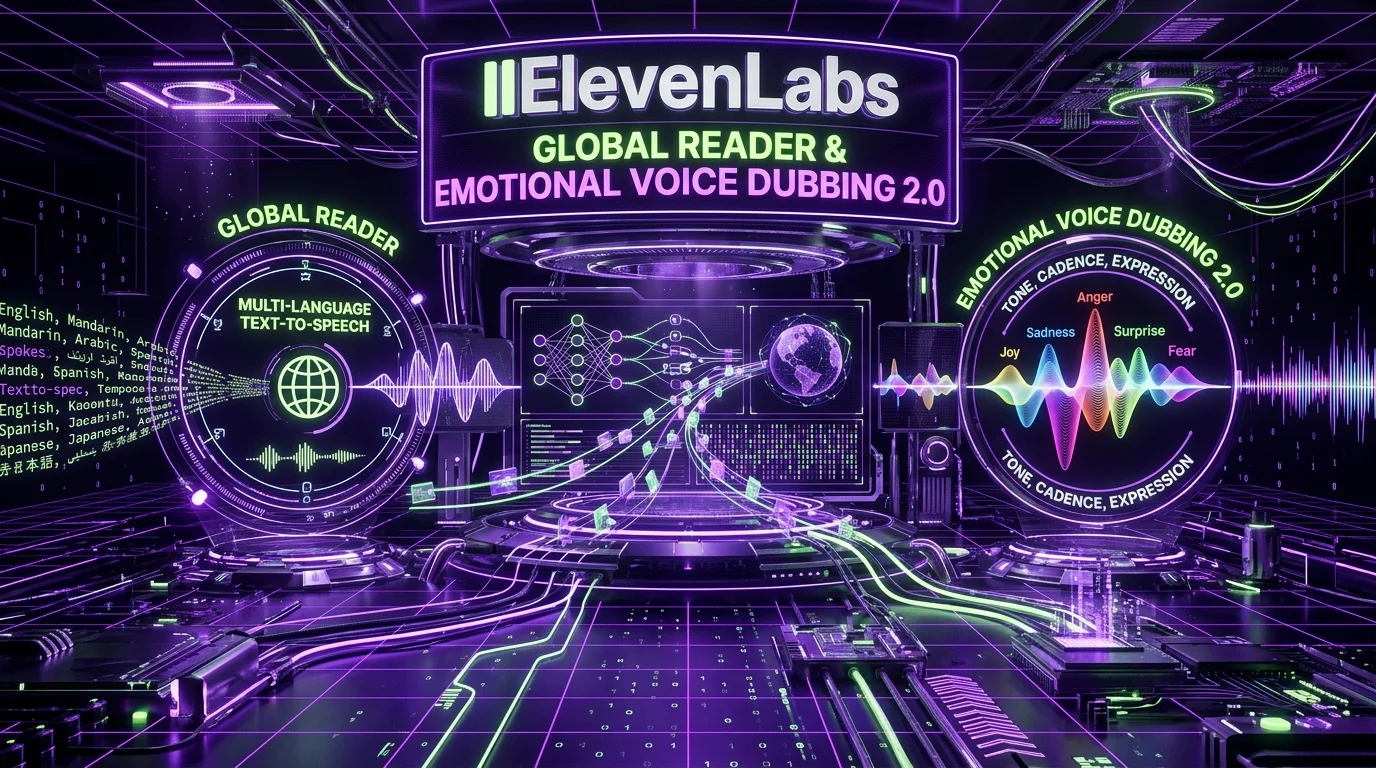
Voice generation leader ElevenLabs has announced two massive updates to its audio synthesis stack: the worldwide rollout of its **ElevenLabs Reader** application and the official release of **Voice Dubbing 2.0**. This update moves AI voice generation past monotonic readings, bringing full theatrical range and emotional pacing to automated translations.
The Reader App: A Portable Audio Library
Initially launched in select markets, the ElevenLabs Reader app is now available globally on iOS and Android. The app allows users to upload any PDF, ePub, text file, or web URL and have it read aloud by a variety of high-fidelity, license-verified voices.
Supporting **32 languages**, the Reader app runs a localized, low-latency text-to-speech engine that adjusts its cadence based on the document type—pacing itself like an audiobook narrator for novels, or delivering a concise, clinical read for research papers.
Voice Dubbing 2.0: Preserving Timbre and Emotion
Translating video content has historically resulted in flat, synthetic voices that fail to capture the original speaker's emotion. Voice Dubbing 2.0 solves this by extracting the **emotional signature** (pitch variability, speed, pauses, and intensity) of the original speaker's voice track.
When dubbing a video from English to Spanish, Dubbing 2.0 doesn't just translate the words; it overlays the exact emotional delivery and vocal tone of the original actor onto the Spanish voice generation, creating a natural and consistent viewing experience.
API Emotional Vectors
For developers, ElevenLabs has expanded its API with emotional control vectors. By appending parameters like `[whisper]`, `[shout]`, or `[crying]` to prompt texts, developers can manually structure how the synthesized voice should perform specific lines, unlocking rich applications in game audio design, animated projects, and localized advertising campaigns.
Get Our Free AI Tools Guide
Join 50k+ freelancers getting weekly AI tips and tool reviews.
Explore Prompt Library →