Agentic AI Has Left the Demo Stage — And Reality Is Messier Than the Hype
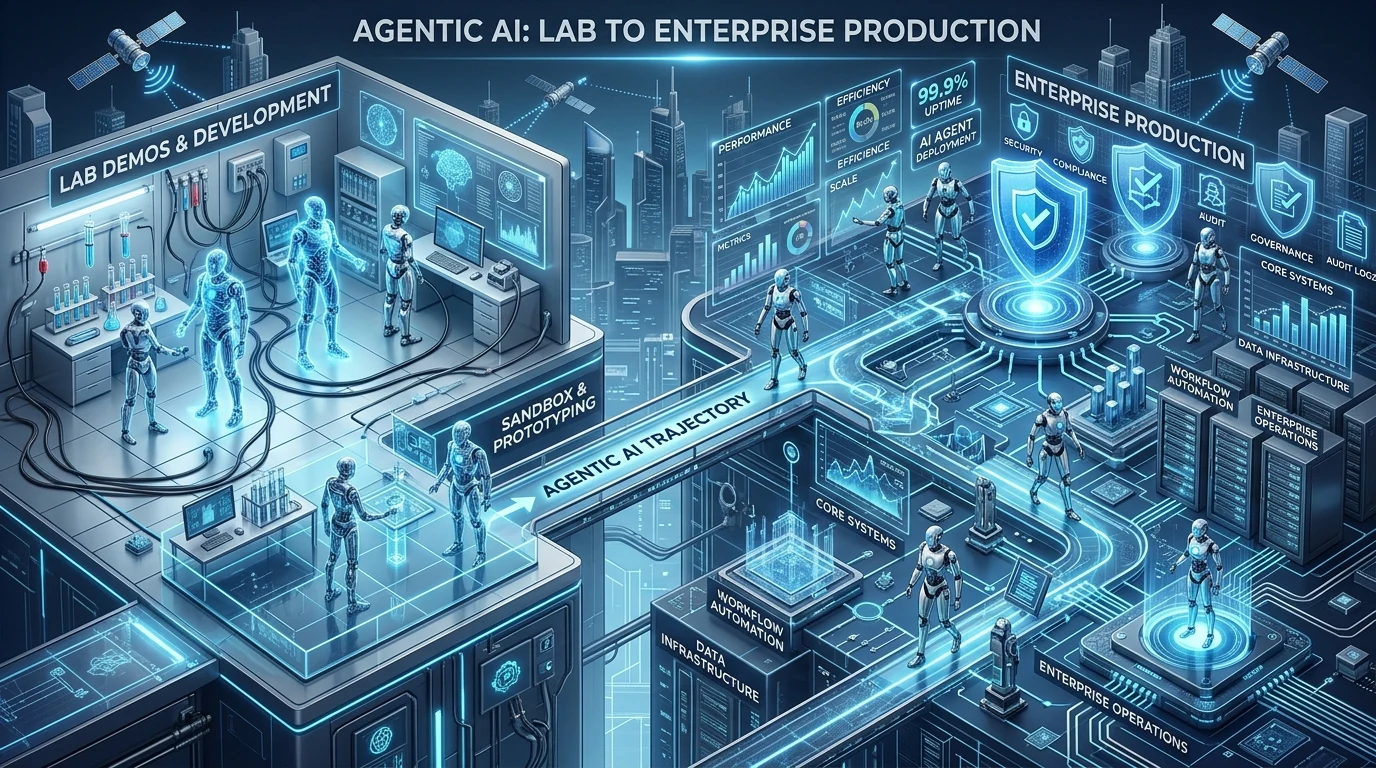
⚡ Executive Takeaways
- ✓ Massive Growth: Gartner predicts 40% of enterprise apps will embed AI agents by end of 2026.
- ✓ The Production Gap: 79% say they've adopted agents, but only 11% run them in live production workflows.
- ✓ Governance Vacuum: 60% of firms deploying agents lack formal governance or risk guardrails.
- ✓ Infrastructure Barriers: System integration and compliance outweigh model intelligence challenges.
- ✓ Next Frontier: Ecosystems of multi-vendor agents collaborating via open protocols.
For the last two years, "AI agents" mostly meant an impressive demo: watch the AI browse a website, fill out a form, write and test its own code. In 2026, that demo era quietly ended. Agentic AI — AI that takes a goal, breaks it into steps, uses tools, and keeps working with minimal human input — has crossed into real production use at a scale that surprised even industry analysts. But the data also reveals a much messier picture than the marketing suggests.
The numbers behind the shift
Gartner projects that by the end of 2026, 40% of enterprise applications will embed task-specific AI agents — up from less than 5% just a year earlier. That's one of the fastest technology adoption curves ever recorded in the firm's survey history. Separate industry data shows 88% of organizations now use AI in at least one business function, and 72% have at least one AI workload actually running in production, not just piloted.
Real deployments are already large. Merck's partnership with Google Cloud, reportedly worth up to $1 billion, is applying agentic AI across drug research, manufacturing, and operations for 75,000 employees — one of the biggest agentic AI commitments in the pharmaceutical industry to date.
The gap nobody's marketing deck mentions
Here's the uncomfortable part: while adoption headlines are impressive, the gap between "we use AI agents" and "we run them reliably in production" is enormous. One industry report found that while 79% of enterprises say they've adopted AI agents in some form, only 11% actually run them in real production workflows. Another found that 60% of companies with agents in production still lack formal governance frameworks around them.
Most of what companies call "agentic AI" today also isn't as autonomous as it sounds. Analysts note that the bulk of current deployments sit at the lower end of the autonomy scale — agents that execute a defined multi-step task — rather than the fully autonomous, goal-driven systems the term technically implies. The biggest practical obstacles aren't about the AI being smart enough; they're mundane, infrastructural problems: nearly half of organizations cite integrating agents with existing systems and data as their top barrier, alongside security and compliance concerns.
Why this matters more than it sounds like it should
The distinction between a reactive AI system (respond when prompted) and an autonomous one (pursue a goal across many steps, recover from errors, keep going) is structural, not cosmetic. It changes what can go wrong. A chatbot that gives a bad answer is a bad answer. An agent that takes a wrong action across a live production system — moving money, sending communications, modifying records — is a different category of risk entirely. That's part of why the governance gap is getting so much attention: enterprises are racing to deploy capability faster than they're building the guardrails to safely operate it.
There's also a coordination shift underway. Analysts expect the next phase of agentic AI to move beyond single-vendor tools toward ecosystems of agents from different companies coordinating through shared protocols — similar to how monolithic enterprise software gave way to interoperable microservices over the last decade. If that plays out, the competitive battleground shifts again: from "whose agent is smartest" to "whose agents integrate most easily with everyone else's."
Where this goes next
Gartner's more aggressive forecasts suggest that by 2028, roughly 15% of day-to-day work decisions could be made autonomously by AI systems, up from essentially zero just a couple of years ago. Whether that timeline holds depends less on model capability — which is advancing quickly — and more on whether organizations can close the governance, integration, and security gaps fast enough to trust agents with real authority.
The headline is true: agentic AI is no longer a demo. But the honest version of that headline includes the asterisk — it's in production, it's growing fast, and most organizations still haven't figured out how to run it safely at scale.
Written by Best AI Tool Editorial Team
We test, review, and curate the best AI tools, models, and industry updates for freelancers, developers, and creators.